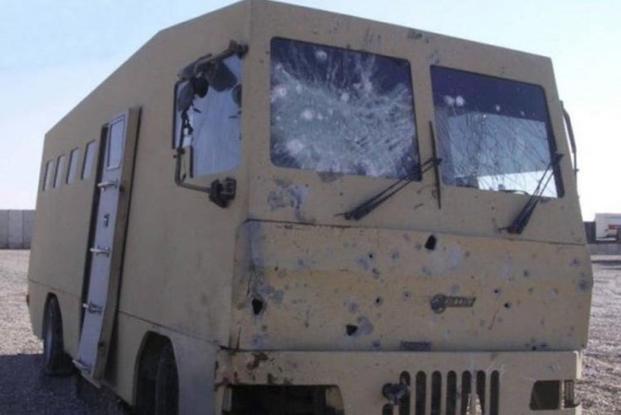
If I casually mention that a situation is FUBAR, all of my military friends nod solemnly, like monks acknowledging an ancient truth. My civilian friends, however, stare at me the way a golden retriever looks at algebra and silently wonder, what exactly is Roger talking about?
BLUF: this got me thinking about the endless military acronyms we use — a secret language requiring its own decoder ring, not unlike the Little Orphan Annie Secret Society Official Decoder Pin from A Christmas Story. Except instead of revealing “Drink Your Ovaltine,” ours usually translates to “You’re about to have a very long day.”
BLUF by the way stands for “Botton Line Up Front,” which means tell me the most important info first, not last. When you are at war you want people to tell you immediately that there is incoming fire, not after you’ve been shot. Typically, it’s used at the beginning of a way too long PowerPoint brief on some mundane ancillary training topic that you are required to take annually. Putting the BLUF at the beginning of the brief allows you to get 1 hour of peaceful sleep without worrying too much if the Sergeant Major quizzes you about it later.
If he does, you can reply, “Yes Sergeant Major, that brief on fire extinguisher use was fascinating, I learned (cite the BLUF) and I feel much safer now.”
You then pretend someone is calling your name and leave before he asks you a follow-up question.
The afore mentioned FUBAR stands for “F**ked Up Beyond All Recognition**,” meaning a person, piece of equipment, or situation has crossed the line from bad into catastrophic. For example, imagine riding through the Red Zone in Iraq inside a Rhino — a commercial bus the Army up-armored for troop transport. It earned the name because it had thick skin and moved slowly, much like your cousin Ralph after Thanksgiving dinner. Now imagine taking small-arms fire and immediately hitting an IED — an “Improvised Explosive Device” planted in the road by people who did not wish you success. Your situation, along with the Rhino are FUBAR.
At least a Rhino was safer than a HUMVEE, a “High Mobility Multipurpose Wheeled Vehicle,” which replaced the famous Jeep, which officially stands for… Jeep. HUMVEE’s provided about as much protection as the filter on filtered cigarettes.
Eventually the Army deployed MRAPs — “Mine Resistant Ambush Protected” vehicles — essentially rolling safes designed to survive explosions while simultaneously recreating the interior climate of a baked potato. Eight soldiers in full battle rattle packed inside one felt like sardines attending a sauna convention while the air conditioner heroically attempted to keep temperatures below 90 degrees despite it being 110 outside.
FUBAR’s close cousin is SNAFU — “Situation Normal, All F**ked Up.” During WWII the Army wisely concluded soldiers ignored boring training lectures, so they created animated training films starring Private SNAFU, a lazy, overconfident soldier who made terrible decisions so others wouldn’t. The cartoons used satire, sarcasm, slapstick, and jokes that would absolutely not pass modern HR review. Amazingly, they worked. One contributor was Theodor Seuss Geisel — later known as Dr. Seuss — proving the road to Whoville apparently passed through military training films. I won’t mention what “training films” mean in the military, this is a PG-rated story.
One of my favorite military terms is FOBBIT, which is not a term for some mystical creature that lived under bridge. Rather it is a term for someone who lived on a FOB, which is a “Forward Operating Base.” FOBBIT was kind of derogatory slang for a soldier who never went outside of the wire or engaged in combat. FOBBITs typically lived in CHUs which were “Containerized Housing Units.” Originally these were actual shipping containers like you see stacked up on cargo ships, where the Army had cut out a door, installed electricity, lighting and AC, and Voilà, it was now your deployed home away from home. Notice, I didn’t say bathrooms. To use the bathroom, you had to hike over to an Ablution trailer which was a community bathroom for you and a hundred of your friends, which smelled like a high school locker room.
CHU neighborhoods were grouped together like trailer parks in West Virginia and had cheerful names like Disneyland, Hollywood, Manhattan, or Palm Springs. My favorite was Mortaritaville at Joint Base Balad, named because insurgents enjoyed launching rockets or mortars at it whenever the weather was cloudy or dusty, when tracking system could not detect the launch point. Unlike Rhinos, CHUs were not well armored. A mortar could arrive uninvited and instantly render everything FUBAR.
They also had CHU cities for Third Country Nationals (TCNs) that housed the employees of the big contractors like KBR (Kellogg Brown & Root). These were poor people from Third World countries that KBR brought to Iraq for cheap labor. Think of the old company owned coal mining towns, just swap out coal dust with sand dust. One thing common between the CHU cities was the fact that all inhabitants had to wear glow-in-the-dark reflective safety belts, comically referred to as a “target indicator belt” because they gave snipers a perfect aim point. Failure to wear your reflective safety belt was punishable by court martial, assuming they spotted you.
I began my military career in SAC (Strategic Air Command), the historic organization established by the legendary General Curtis Lemay. SAC had a reputation for being a very disciplined and unforgiving command that required absolute adherence to rules, regulations and standards. And rightly so when dealing with nuclear weapons daily. To be certified to pull alert you had to take a “Check Ride” in a missile system trainer where they threw every problem in the world at you in the matter of a couple grueling hours. If you passed you got the honor of pulling alerts, if you did not you had to don your formal “Class A” uniform and make the march of shame to the Commander’s office and explain why you failed. When you passed someone in the hallway wearing Class A’s you looked away, not wanting to feel their shame, and knowing you could be next.
You also had to take monthly weapon system, codes, and EWO (Emergency War Order) tests, with the expectation of obtaining a perfect score. Failure was not an option. Due to the continual stress of monthly tests and trainer “rides” many crewmembers referred to SAC as “Screw All Crewmembers.” Later in my career this would become known as BOHICA, “Bend Over Here It Comes,” which meant leadership was about to require you to do something that wasn’t going to be fun, like repaint all of the buildings and equipment because the new Commander chose a different color scheme for the command. Like in the early 80s, when Tactical Air Command (TAC) Commander, General Wilbur Creech, wanted to standardize base appearance across all TAC installations. He directed all buildings, hangars, equipment, and ground support gear to be painted in standardized earth-tone colors: brown, tan, or subdued neutral shades. They even named a color after him, Creech brown. I still feel nauseous when I see a similar brown color
The military loved to give its uniforms acronyms too. In the 80s and 90s, you had BDUs (Battle Dress Uniform) and when deployed to the desert you had DCUs (Desert Combat Uniform). Then in the 2000s the services evolved to Airman Battle Uniforms (ABUs) that were hot as hell in the middle east, and the Army’s (ACU) Army Combat Uniforms, which were so thin they were like wearing cheese cloth and only lasted about a month when deployed.
At some point an Iron Major on the Joint Staff realized that it’s hard to call yourself a Joint Task Force when everyone was dressed differently so they started issuing (OCPs) Operational Camouflage Pattern, to all Service members. This was a form of BOHICA, because every time there was a uniform change you had to go out and buy a whole new set of uniforms, to include patches, then you had to get the patches so on, and then you had buy new boots to match. So, there went a couple of hundred dollars every time there was a uniform change. I went through at least half a dozen uniform changes and have so many boxes in my basement full of various uniforms that I am thinking of opening my own Army/Navy Supply store.
When I started my career in SAC as a missileer I was issued free blue cotton uniforms which looked great when they were first issued but faded over time as they were cleaned and starched. Walking through the hallways of the operations building it was easy to tell the difference between the seasoned veterans and the FNG because the veterans’ uniforms were light blue while the FNGs were dark blue. FNG stood for the “F**cking New Guy,” who was the rookie or new guy who showed up acting like he knew everything. I can still vividly recall a good buddy saying annoyingly, “Can someone tell the FNG to shut the F*ck up, he doesn’t know how FUBAR this place is. And if you haven’t figured it out yet, more than half of the Fs in military acronyms stand for F*ck, the most common word in a soldier’s vocabulary.
Luckily for the veterans they eventually got orders before they became too cynical, and with orders in hand they could go FIGMO, which stands for “F*ck it, I Got My Orders.” This meant that they didn’t care anymore because they were leaving soon and didn’t have to put up with anymore BOHICA stuff. Of course, leaving without orders is seriously frowned upon in the military, and is called AWOL, Absent With Out Leave. Doing so would be a serious SNAFU.
In addition to the many acronyms the military also has a plethora of terms and phrases that are unique to military service. One of my favorites is when you are Voluntold to do something. This is when leadership asks for volunteers for some BOHICA like activity and no one volunteers, so they order you to do it. Like after an Airshow, and someone says, “we’ve been Voluntold to do a FOD (Foreign Object Debris) walk,” where we have to walk side by side with hundreds of other Voluntolds picking up corn dog sticks on the taxiway after the Airshow instead of the job we normally do.
To reward us after being Voluntold to do something leadership then organizes a Mandatory Fun activity. This is characterized as a “fun” activity intended to build morale and unit cohesion but instead drained our will to live. Like, let’s all do a 5K run at 0700 in the morning when it’s 12 degrees outside, or run the confidence (obstacle) course when it’s 90 degrees. The only thing you are confident about is that someone will get hurt and the poor safety officer will spend the rest of the day filling out a safety report. The Mandatory Fun events do in fact increase unit cohesion because afterwards everyone in the unit despises the unit leadership.
Another morale killer is when you are ordered to show up for an event like a bag drag deployment exercise at 0600, you get up at O’Dark Thirty and scrambling around in a rush to get there, and then you are told to wait, and wait, and wait some more. This is infamously called Hurry Up and Wait and explains why military troops are notorious for being able to sleep anywhere. The bag drag refers to all of the bags of gear you drag around during the exercise. One bag for clothing and uniforms, one for your chem-bio suit and mask, one for equipment, and one full of Doritos, Rip It high energy drinks, and Clif nutrition bars, to keep you nourished and awake when you needed to be. Every DFAC (Dining Facility) in a deployed location had cases of Rip It and boxes of Clif bars at the exit doors for evening snacks and to keep you awake if you had night duties.
Often though when you were deployed, your unit needed supplies or a piece of equipment that wasn’t as readily available as Rip Its or Clif bars. This is when your crafty veteran accomplished a Tactical Acquisition, which meant they “borrowed” this item from another unit. Afterall, we were all in the same military, and the Supply unit has 54-inch TVs all over the place, so we just “relocated” one to our workplace. A few days later some High-Speed Lieutenant from that other unit would wander by and ask where we got that new 54-inch TV. High Speed typically meant it was some junior member who was overzealous, rules driven, and always trying to impress leadership. You would reply, “I dunno, do you need a case of Rip Its?”
When he attempted to take the TV back you would say that you really needed it and your unit didn’t plan for it when they deployed. He would then smugly reply, “Lack of planning on your part does not constitute an emergency on mine.” Which is one of those military phrases that translates well into everyday life. Like when your wife gets upset that you packed bourbon for your picnic, but no Rose wine.
I had the distinct pleasure of being embedded in the Army for 2 years and they have their own service unique terms and acronyms as well; most famously is the term Hooah. The beauty of Hooah is that it’s a universal term which can be used in differ ways depending on the situation. Traditionally it means affirmative, like when the Commander says we are going to win this battle and kill the bads guys, and the troops respond in strong unison, Hooah! However, if the High-Speed LT gives a confusing or stupid order the response may be quizzical, like Hooah? And it can even be used to show disappointment, like when you are Voluntold to participate in some Mandatory Fun, you respond unenthusiastically, Hooah. The key to understanding the response is all in the tone, much like when your teenager responds to you asking them to clean their room.
One thing the Army relishes is applying combat terms to everyday situations, like when discussing a simple, easily fixable problem as the 50 Meter target. Or when it was time to take action, they said “move out and take fire.” It would be good if we could get a few Congressmen to move out and take fire now, instead of rage Tweeting on X.
The Army likes the “F” word too. One Viet Nam era acronym was “Rear Echelon Mother F**kers” (REMF). It’s similar to the modern term FOBBIT and referred to the people back at the HQ who were well behind enemy lines, making poor decisions that would result in everyone becoming FUBAR. These were the same people that inspired Army soldiers to say, “We can do this the easy way or the Army way,” which was their tongue in cheek way of saying the Army always made things harder than they needed to be.
Among the many unique experiences I had with the Army in Iraq was visiting their TIFRICs, which referred to “Theater Internment Facility Reintegration Centers.” It was fancy way of saying prisons, without saying prisons because legally we weren’t allowed to hold prisoners without due process. These TIFRICs were typically filled with very bad guys who were too dangerous to release, or someone would end up FUBAR. Since they weren’t technically prisoners we could not say they escaped, but rather we would say they self-released. I often want to self-release from a boring meeting or a mandatory fun event.
My favorite Army term, however, was Chair Force, which is their derogatory term for Air Force personnel who had it easy and did not typically go outside the wire, but rather fought from a chair on a computer. They usually added in references to playing golf and staying in nice hotels too. I would be offended by these remarks if they weren’t true.
I still recall a bad situation at Camp Basra, Iraq when I was deployed with the Army. The contractor supporting the FOB had defaulted and we were scrambling to get the base essential services. My replacement had arrived and asked me for a rundown on the deteriorating situation, I replied:
“BLUF: The situation is FUBAR. But I am FIGMO so I don’t really care what the FOBBITS back at HQ think. If you need help ask the FNG, he is High Speed and I am sure he can fix this SNAFU. If not, we’ all end up in a TIFRIC. Until then grab a Rip It and a Clif bar at the DFAC and don’t come looking for me, I have Self-Released. Hooah!”
 Bourbon Tales